Showing posts with label Portfolio. Show all posts

Sunday, 23 October 2016

Tips For Doing Caricature Gigs

I have recently added Caricaturing to my repertoire as an artist, I have had two gigs so far and I'd like to share with you what I have learnt from doing them.

First of all I am not doing the really exaggerated, highly rendered kind of caricature drawing like Jason Seiler for example. My ‘caricatures’ are black ink line drawings of the people who sit in front of me, drawn as a representational portrait or portraying them as popular person or character of their choosing.  

I did not plan to start caricaturing, I did it on a whim, I decided to run a caricature stall at the school-where-I-work-at’s Summer Fair, just for fun to see if I could actually do it and to raise some money in the process.  As it was the first time I have ever done anything like this I was very nervous at whether I would get recognisable likenesses, be fast enough and be good enough.  I think what gave me the confidence to try is the legacy of taking part in Inktober where you aim to make an ink drawing every day in the month of October, as a result I haven’t stopped near-daily drawing since taking part for the first time three years ago.  

So at the school’s Summer Fair I set up a stall which consisted of an easel displaying some sample caricatures that I had made earlier and a banner saying ‘caricatures’ and the price of a drawing.  I had an easel to draw at, a chair for me and a chair for the sitter.  I made sure I had plenty of paper, pens and at the last minute I grabbed a pencil with a rubber on.  For requests of whom to be drawn as I used an iPad to Google for images. 

School Fair Caricature Setup

When the first guests arrived I asked if anyone wanted a drawing and immediately someone took me up on the offer.  After that there was a crowd around me from every angle and an unorganised queue formed.  I drew in pencil lines first then inked over them with Posca markers.  I drew nine portraits in an hour and a half.  The thin pen I favoured ran out towards the end and I had to switch to my thicker one.  The rubber on my pencil wore down and for the last couple of drawings I asked the sitter to rub the pencil out when they got home.  

Birtley Library Caricature Setup
I learnt some great lessons from doing this which helped me in my second gig at my first ever Library event as part of Geek Con 3 at Birtley Library.  I kept a similar physical setup but also displayed some prints for sale (See below for the Bellatrix Lestrange portrait I made especially to sell at the event).  I felt more confident this time and decided to ditch the pencil and drew straight away in pen, this time my favourite Pentel Pocket Brush pen, this, of course, helped me create more time to make more drawings.  To avoid a chaotic queue and any disappointment at not getting a drawing, I had a time slot sheet which I managed to keep to.  So my second caricature gig was even more successful than the first and I am making arrangements for my third gig next month.  See some of the caricatures below:

Bellatrix Lestrange

A photo posted by Claire O'Brien (@claireobrienart) on

A photo posted by Claire O'Brien (@claireobrienart) on


A photo posted by Claire O'Brien (@claireobrienart) on

Things to work on for next time are;

  • better packaging for the customer to take their drawing away in without it getting crumpled
  • have more prints for sale
  • improve at drawing hands, they are such an important part of portraits

Just as caricaturing was a new experience for me, I am about to try something else new!  For my third Inktober I have decided to draw a mini comic (of Kate Bush’s Under Ice song).  As well as drawing a comic for the first time (well apart from this page below my son and I made) I will be doing it as live-ish online as a Facebook event. So please click ‘Going’ if you like to watch my progress, I’ll also have giveaways and art drops to announce, thank you.

Thursday, 30 June 2016

Creating A Children’s Picture Book Illustration Portfolio - Part 4 - Drawing Children

How do you draw children?  When creating a children’s picture book illustration portfolio, you need to have work that features children.  In a picture book, whether human, animal or robot, the main character is nearly always a child, this is something that I forgot to say in my blog post about format and content.  I have recently added these two new pieces to my portfolio and as you can see I have found it a challenge to make my characters look young, in fact it is difficult to work out what age they actually even are.    So, in this post, I aim to find out how to draw children.  
  
Red Meets The Wolf by Claire O'Brien

Bringing Home The Loot by Claire O'Brien


What Do The ‘How To’ Books Say About Drawing Children?
First port of call has to be some of the many ‘how to illustrate children’s picture books’ that are out there, to see what they advise about drawing children.


Observation
The consensus seems to be to observe children and draw them from life.  Uri Shulevitz says in his seminal Writing with Pictures: How to Write and Illustrate Children's Books
“It is best to draw from direct observation of nature - figures, landscapes, animals, plants, inanimate objects - as much as possible.  In this way you have clear references against which to compare and correct your drawings.  Artists who draw exclusively from imagination run the risk of drifting into vagueness.” (Shulevitz 1997, p136) 

As always, this is good advice as it basically boils down to ‘learn how to draw by drawing’. Below are some of my observational drawings, this is something I do as much as I can.  From our observational drawings of children what do we learn about how make our own children character designs that we use in our picture books look more childlike? 


My own observational drawings

Scale - Proportion Charts
After observation, the first thing that strikes me about children is their size, they look small next to adults and everyday objects.  So let’s look at children’s proportional anatomy first.  I’m not keen on the proportion charts in ‘how to draw for children’s picture books’ they are not objective enough for me.  I find there are better proportion charts in regular ‘how to draw’ books though most just show the adult male, some do have charts for the adult female and a few show comparisons between the genders and ages.

In my opinion, the most useful human anatomy proportion charts for Children’s Picture Book Illustrators are by Andrew Loomis.  We have to remember that proportion charts establish rules for an ‘ideal’ figure and are measured out using a unit that is relative to the size of the figure's head. Loomis' ideal is an adult of eight heads high, in reality the adult is probably seven and a half heads high.  The demarkation of where the eight head units fall on the body, line up with body landmarks such as the nipples, the navel, the elbows, etc and that helps us learn the proportions of the ideal figure. 


Loomis' adult male and female 'ideals' from Figure Drawing For All It's Worth


Beware when using some proportion charts, for example, while How to Draw Comics the Marvel Way is a great ‘how to draw’ book its eight head ideal proportion chart is a bit illogical to actually use, it has extra arbitrary proportion lines added at the neck and feet.


Also a lot of proportion charts state that women are seven and a half heads high to show that they are often shorter than men.  Again I prefer Loomis' method of an eight headed high female ideal.  Using seven and half heads makes it difficult to memorise where the subsequent head unit demarkations fall. I think the solution to drawing women shorter than men is to make their heads slightly smaller, as shown below, the red line shows the measurement of the women's head.  I might be wrong in doing this, what do you think?


Comparative Proportions
Okay so now that we are familiar with adult proportions how do they compare with children’s proportions? If we were to increase a child’s height to an adult’s we see instantly they have differently proportioned anatomy as the picture below shows.


As Loomis shows us below children's heads are smaller than adults' but they are larger in proportion to their own bodies. Children are not eight heads high, the numbers of head units vary at different ages starting with just 4 at one years old, 5 at three years old, 6 at five years old and 7 at ten years old. Arms and legs are relatively very short between one and three years old and he neck doesn't start showing until five when the shoulders start to widen. 


As well as covering whole body anatomy in Figure Drawing For All It's Worth Loomis goes into great detail about drawing babies, small children, school age children and teenagers' heads and hands in Drawing The Head And Hands.


From Further Reading
As well as Loomis' proportion charts there are some great written tips about drawing children;

In William Rimmer’s very unusual Art Anatomy book he gives this formula for drawing children:

  • Large head
  • Rounded cheeks
  • Short neck
  • High, narrow shoulders
  • Rounded abdomen
  • Narrow pelvis
  • Limbs large in proportion to small hands and feet

And in Barbara Bradley’s brilliant book Drawing People she says;
  • Babies' heads are very square both from the front and in profile.
  • Babies have a wider space between the eyes than adults.
  • Babies' cheeks reach down to the chin and sometimes farther.
  • Most babies have a lot of fat, it's pretty much gone by the time they are seven.
  • The curve under babies' chins is convex.
  • Missing teeth happen at around seven years old.
  • Babies have fat hands and feet.


My Own Observations
Here are my own observations I have made while drawing children from life, they have:


  • Large foreheads
  • Big eyes, wide apart
  • Transparent eyebrows
  • Upper lips that are more prominent than the lower
  • No lines or wrinkles on the face
  • No or a short neck
  • Chubbiness
  • Short arms
  • Big nappied-bottoms

Conclusion
So hopefully I have given you some useful things to think about and apply when drawing children for a children's picture book illustration portfolio, do let me know in the comments and also if you have anything to add.  I have certainly found this research useful and have made the following couple of watercolours as a result:

A two year old by Claire O'Brien

An eight year old by Claire O'Brien


Further Reading/Viewing

  • Check out Stan Prokopenko's Videos they are an essential guide to drawing human anatomy and proportion, and drawing in general.
  • This TEDx talk The Myth Of Average made me think of the 'ideal'. Just as the 'ideal' doesn't exist neither does average.  We all have a 'Jagged Size Profile' and this is something to bear in mind when drawing in individuality into our characters.
  • And finally, below, is a great real-life example of an Art Director, Lauren Rille, giving feedback on illustrator Robert Neubecker's initial illustrations on how to make the portrayed children more childlike in Sarah WeeksSophie Peterman Tells The Truth.


Lauren Rille's Feedback to Robert Neubecker on his initial Character Designs


Lauren Rille's Feedback to Robert Neubecker on this Spread

Saturday, 31 October 2015

October / Inktober 2015

October is my favourite month of the year as it is my birthday month and because of Halloween, I just love spooky things.  I’ve been working on some portfolio pieces and this one is appropriate for the season; a witch taking a night flight as a swarm of bats spirals by.

Night Flight by Claire O'Brien
Night Flight by Claire O'Brien, 2015, gouache on paper


I took part in #Inktober again this year.  Just to recap, Inktober is a drawing challenge to make one ink drawing a day for the entire month of October.  Inktober was started in 2009 by an artist called Jake Parker, who set himself the challenge to improve his inking skills and develop positive drawing habits.  I am pleased to say that I made a drawing every day except for the last.  

Doing Inktober was as fun as last year, I even took some requests this year for subjects to draw which added to the challenge. Inktober really motivated me to draw every day and the quality of drawings ranged from throwaway sketches to not bad, I even sold some prints and have been commissioned to draw in my ink style.

You can see all of my Inktober drawings on my Facebook page but here are are some of my highlights:

"Playing in the Garden" by Claire O'Brien

"The Gentleman" by Claire O'Brien

"I Found a Fox" by Claire O'Brien

"Kate Bush - Before The Dawn" by Claire O'Brien
"Halloween" by Claire O'Brien

There was also lovely a meet up of some sociable SCBWIs, Top, 2016 Carnegie long-listed, YA author Teri Terry was in town for writing research so a gang of us had dinner and viewed the SCBWI Illustration Showcase exhibition at Seven Stories.

Geoff Lynas, Maureen Lynas and Janet Foxley outside of Seven Stories

Teri Terry, Geoff Lynas, and Maureen Lynas

"Maureen and Teri" by Claire O'Brien

Up month is Tara Lazar's PiBoIdMo - Picture Book Idea Month a where you come up with an idea for a picture book every day of November.  


Saturday, 20 June 2015

Promotion

I have had quite a fun-filled children’s book-related month so far, I have been to some promotional events, I have even been promoted myself and there are some great opportunities for more promotion to be had, not just for me but for other aspiring children’s picture book author and illustrators too!

Promotional Events
First up was Seven Stories’ Jodi Picoult talk and signing at the lovely Tyneside Cinema.  Jodi and her daughter, Samantha Van Leer, have co-written a YA (Young Adult) novel “Between the Lines” that is a book about a book, a fairytale book, with characters coming out of the page.  Jodi and Sammi gave a great talk, the pair of them in conversation, no compere!  The book also features striking illustrations by Yvonne Gilbert and enchanting silhouettes by Scott M. Fischer.  Let’s hope we see more YA novels with illustration adorning their pages in the future.


Next up was the launch of Gabrielle Kent’s Middle Grade novel “Alfie Bloom and the Secrets of Hexbridge Castle” at Stockton Library.  I’m so excited by the book because I’m a friend of Gabrielle. We met at Teesside University when she was my tutor and then, when I worked there, my colleague.  “Alfie Bloom and the Secrets of Hexbridge Castle” is her debut and it is the start of a series.  It was a lovely book launch with readings, signings and fun activities for children and Stockton Library looked like a really good libary.  I’m so pleased for Gabrielle and look forward to seeing how her writing career turns out and I know she is cheering me on in my own writing endeavours.


The last of the events that I went to were some illustrator talks that kicked off The Festival of Illustration in Hartlepool.  The talks that I attended were great, they were by Chris Riddell, John McCrea (comic artist) and Sara Ogilvie. The festival has been well-organised by Cleveland College of Art and Design and the main illustration exhibition and is held in the beautiful former church, Hartlepool Art Gallery.  The exhibition runs between the 4th June to the 4th July and it is well worth a look (and a second visit from me) as it features some top illustrators all-round and as well as children’s picture book illustrators.   I attended with some SCBWI friends and it was nice to meet Chris Riddell, little did we know he was about to become the Children’s Laureate, check out his five point plan for the role. 

 
Left to Right: Lucy Farfort, Claire O'Brien, Maureen Lynas,
Chris Riddell, Cathy Brumby and Katherine Lynas

Chris Riddell by Claire O'Brien 


Promotion of Me
This month saw the release of my first ever interview!  It was for the brilliant Kidlit TV who have featured me as their Community Member of the Month for June.  KidlitTV is a great community and YouTube channel that features original Kidlit content, particularly fantastic interviews with authors and illustrators in their ‘Story Makers’ series (a title I came up with).  As well as providing great content, the Facebook group is a mine of information about video creation and marketing, so if you make videos, you need to join.


SCBWI has launched a new email magazine INSIGHT, every month there is a drawing prompt for members, everyone who submits gets included in the gallery and two are picked to be featured in the email itself.  This email will reach agents and editors so it is worth submitting to.  You can see my entry for the ‘Bounce’ prompt here, leave me comment if you look.


Let’s Get Promoted
I have already mentioned being featured in SCBWI’s Draw This prompt, this month’s prompt is ‘Adventure’, here are the guidelines if you’re a SCBWI member and wish to submit, but hurry, the deadline is June 20th.

Another SCBWI opportunity is Undiscovered Voices, a competition for unpublished and unagented children's book writers and illustrators living in the EU.  Submissions are open on the 1st of July and close on the 16th August.  The illustration criteria give the opportunity for drawing some twisted fairy tales 

Here’s a contest to win a critique from talented illustrator, teacher and YouTuber Will Terry and $30 credit to his SVS online courses by submitting an illustration to the prompt of: “Amanda was so excited for her first day at the cottage until…”.  The deadline is 12:00 noon EST, June 25th.

And just for fun and cool prizes there is Susannah Hill’s illustration contest on the theme of Discovery, you have until the 26t of June to submit.

Good luck with these if you enter, why don’t you post a link if you do, I’d love to see.  Thanks for reading.

Friday, 27 March 2015

Creating A Children’s Picture Book Illustration Portfolio - Tips for Improving Your Portfolio - Part 3

This post continues my series about creating a children’s picture book illustration portfolio. First I covered quantity and quality and then I covered format and content. In this post I dig deeper into content and suggest some tips and tools for improving your work, I start by showing the new work I have added to my portfolio (if you just want the tips scroll down to the end of this post):

"The Four Seater", Gouache by Claire O'Brien

"Laughter in the Leaves" Ink by Claire O'Brien


"Boy at the Computer" Pencil by Claire O'Brien
"Boy at the Computer" Pencil by Claire O'Brien 

"Horsebox" Ink by Claire O'Brien
"Horsebox" Ink by Claire O'Brien 


In previous posts I established that my aims are to:
  • Produce work in a landscape format.
  • Produce consistent looking sequential images that feature characters doing different actions and showing different emotions.
  • Include more settings/backgrounds (move away from white backgrounds)

I have removed “When Mum Came Back”  because it is in portrait format and on a white background.  I have removed Jack Frost as, though it has a background, it is in portrait format and is too ‘Fantasy’ to stay (I may remake this image one day, as I would like to try and the capture a winter scene and the Jack Frost character more successfully and in a children’s picture book style).

“When Mum Came Back” Gouache by Claire O'Brien
"Jack Frost" Ink and Watercolour by Claire O'Brien
"Jack Frost" Ink and Watercolour by Claire O'Brien 

As a result of these changes, I have increased the quantity of my portfolio from six images to eight and hopefully raised the quality too.  The majority of the images are in landscape format now but I must aim for all of them to be.  The new illustrations don’t add enough action, the dogs in the horse box, the family on the sofa and the boy at the desk are all at static and at rest really.  Only the girls laughing in the leaves are mid-action. I’m not sure if I have successfully shown different emotion yet too with the new work, there is joy in the girls in the leaves and tiredness of the family on the sofa but neither of these are sequential which help show a change in their emotions.  Unfortunately there are no background settings in the new pictures so I have actually added more white space! 

My Portfolio at a Glance by Claire O'Brien


What tips will help me, and you, improve our portfolios?  Here are three suggestions:

Make Lots of Work! 
The more work you make, the more chances you’ll have of increasing the size and quality of your portfolio.  If the standard of your work is not yet portfolio-ready, making lots of work gets the bad stuff out, as Disney animator and drawing teacher, Walt Stanchfield said: 

“We all have 10,000 bad drawings in us. The sooner we get them out the better”.  

Making lots of work helps you practice your craft, you can only improve!  If you are stuck with what to make work about, draw from life so you do not rely on your style and what you think things look like, again this can only improve your work.


Look At The Best Work Currently Being Published!
Analyse what the illustrators and designers are doing in a children's picture book spread so that you can emulate it in your own work.  Look at the backgrounds, are the characters in white space or in a fully illustrated setting?  What sort of settings come up a lot?  Where are the characters placed in the spread?  Does it change depending on viewpoint? Long shots, closeups, bird’s eye views, etc. What are the characters doing? What do their poses, gestures and movement directions show us about what is happening in the story?  Does the character’s pose and expression convey an emotion?  Does the lighting echo the emotion, add to the mood?  Where has the illustrator left space for the text? Is it a white space or a quiet part of the illustration?  Is the illustration in duet with the text, showing what the text says or is it counterpoint and saying something different? 


Evaluate And Be Critical About Your Own Work!
Look at your work as a whole, add all of your portfolio images into one document and look at them on the screen or in a print out.  What stands out? Is it for good reasons or bad?  What similarities are there?  Look at the viewpoints you have used, where is your camera? Is it always close, far away, straight on?.  What are your backgrounds like?  Non existent like mine or fully realised?  Do you always use the same colour palette?  Is it always saturated or muted? Do your characters always face the front or the side but never anywhere in-between?  Are they always making the same pose or expression?  Do your characters look different to each other? Are they the same gender or age?  If all these things are similar, draw them differently to show variety and skill in your work.


Well, I still feel my portfolio does not quite fit the bill of a children’s picture book portfolio yet.  I’m going to follow my own tips and really focus on creating sequential images that feature characters doing different actions and showing different emotions in a background!  I’m also going to start a series of monthly posts called “Spread of Wonder” where I’ll present an example of a published children’s picture book spread that I admire and tell you why I think it is so great, follow my blog so that you get a notification of when I post it. And if you are stuck for what to actually draw check out these great suggestions from Robin Rosenthal.

Sunday, 30 November 2014

Creating A Children’s Picture Book Illustration Portfolio - Format and Content - What to Put In? - Part 2

In my first post on the subject of Creating A Children’s Picture Book Illustration Portfolio I talked about the quantity and quality of the images.  In this post I’d like to explore format and content, by that I mean what the actual images show and how they are presented.  I will use my findings to create action points for me to apply to my own portfolio as it presently stands.

The Format of Children’s Picture Book Illustrations
Based on my observation of current children’s picture books, illustrations destined for the printed page are mostly printed in landscape format, spanning double page spreads.  In the past we saw more of single spread images and spot images and these are useful if you need more than the allocated 32 pages to tell the story.  

The Content of Children’s Picture Book Illustrations
Illustrations in children’s picture books are sequential in that they have multiple images that tell a story that happens over time.  This means that there is a requirement to be consistent in their execution, characters have to be ‘on model’, that is they have to have the same proportions and features and wear the same clothes from page to page (unless the story dictates otherwise).  Colours have to match from image to image.  Locations and props also need to be consistent in the same way.  Sequential storytelling art by its nature shows characters doing lots of actions and having different emotions and feelings.  And again, unless the story demands it, the art is produced in a consistent same style and medium. 

Appraising the Format and Content of the Work in My Own Portfolio
Okay, here is what my portfolio currently looks like, as whole, as seen on my website:

Claire O'Brien Art Portfolio

Disregarding its quality, I have a minimum desired quantity of six illustrations, of mainly human subjects, painted traditionally with gouache on paper.  I also have a digital piece, an ink and watercolour and a scraperboard.  

Venice Children's Picture Book Art Claire O'Brien


This is a tonal gouache sketch of a spread from one of my picture books that I am working on.  I think it is the strongest piece of work in my portfolio as it is has storytelling and is in a complete setting that conveys mood and atmosphere.  This has been affirmed to me by its selection in the 2014 SCBWI (British Isles) Showcase Exhibition a goal that I expressed a wish to achieve back in July when I helped to hang the 2013 Showcase at Seven Stories.

Children's Picture Book Art Claire O'Brien


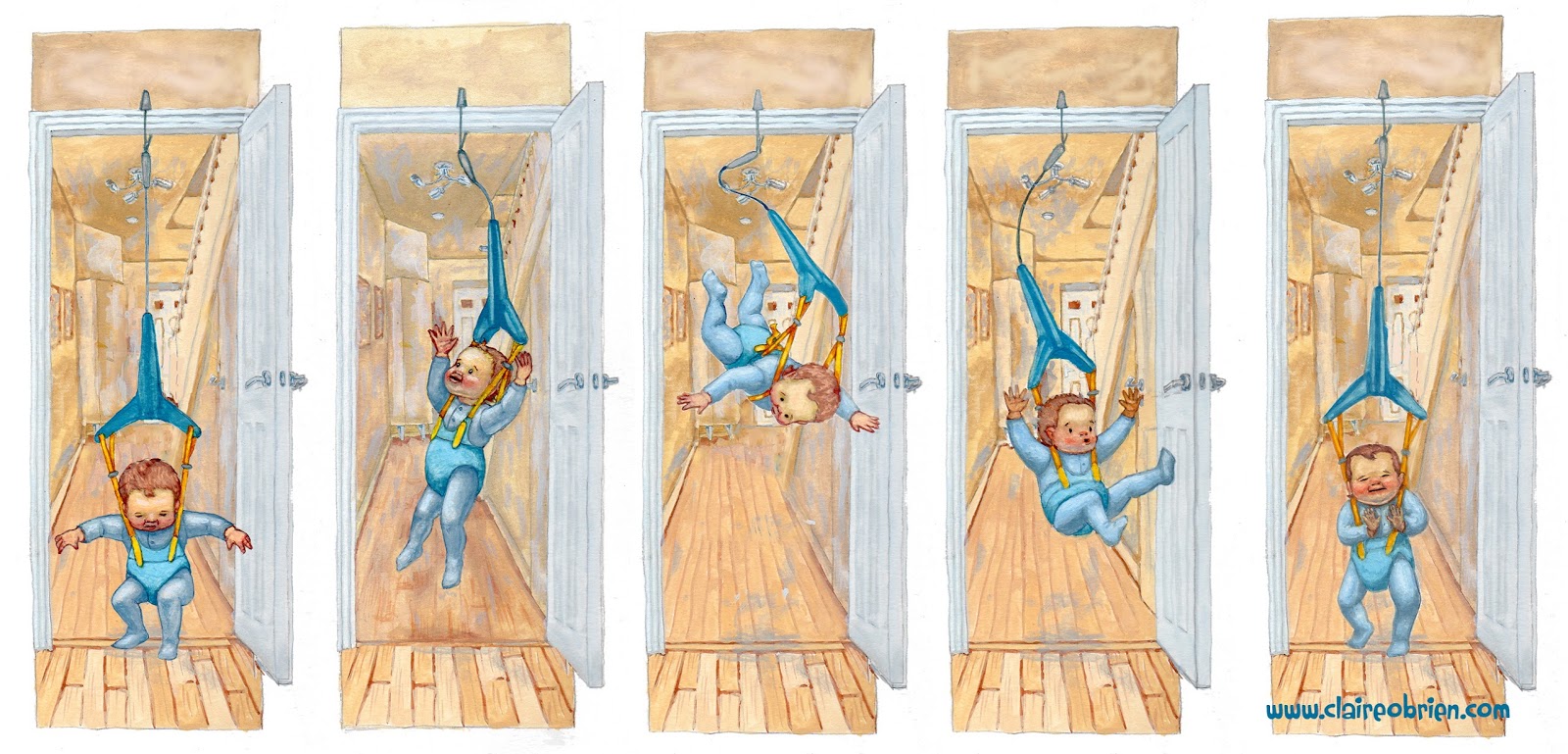
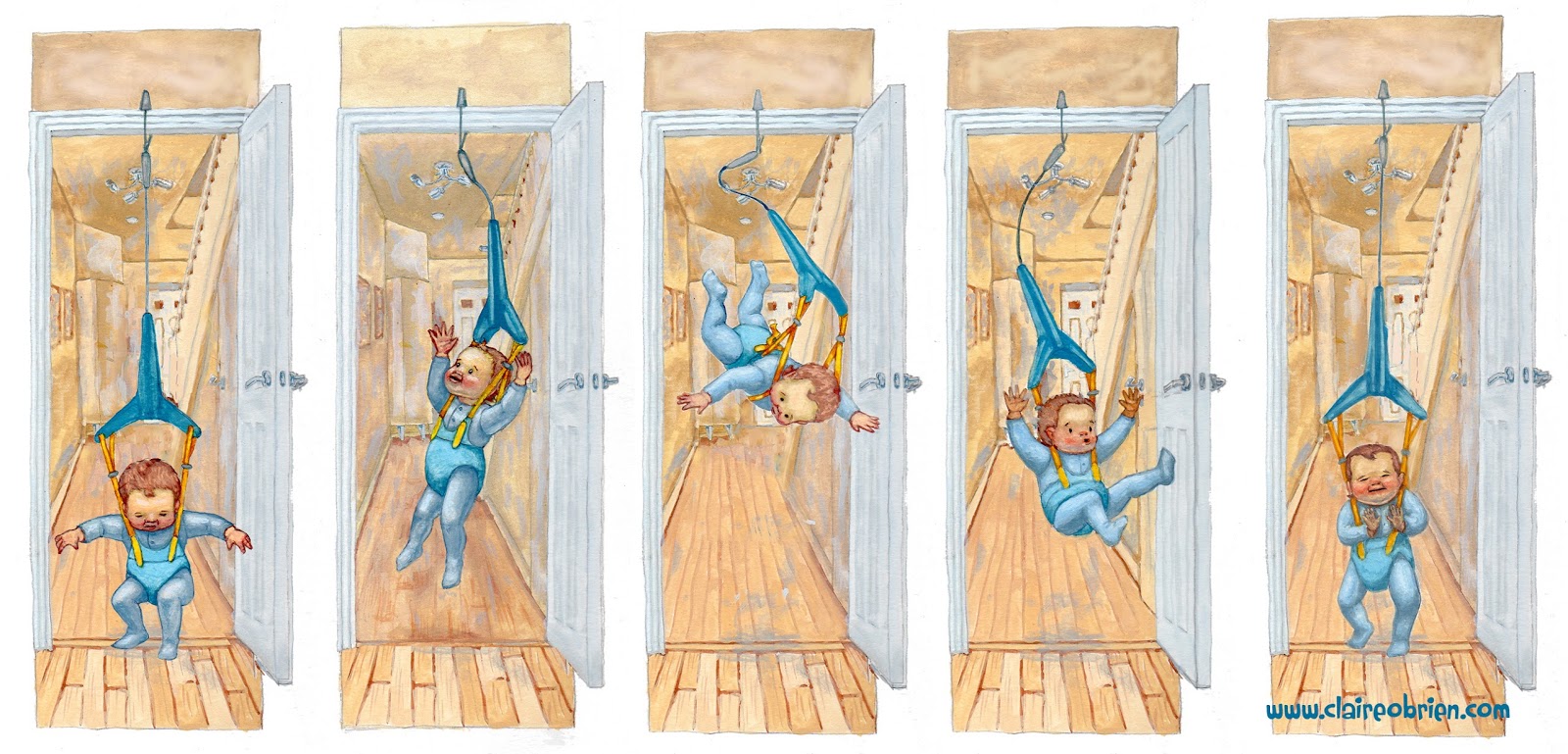
Baby Bouncer is painted in gouache with a touch of digital, set in an interior setting, it hopefully shows consistency in depicting a character and is sequential showing different emotions and action.

Claire O'Brien Art


When Mum Came Back is a gouache showing a group in exaggerated action, with different emotions.

Children's Picture Book Art Claire O'Brien


Outdoor Girl and Sidekick is me trying to capture my gouache style digitally.  I like the characters but I'm not sure of their emotions here, they're perhaps a bit neutral.

Jack Frost Art Claire O'Brien


Jack Frost is painted with ink and watecolour and is me attempting to draw like Arthur Rackham. Things in favour of this illustration are that is set in a forest setting and I like the rendering of the body.  The storytelling not quite there and the aesthetic is perhaps more fantasy than picture book. 

Art Claire O'Brien


This Crooked Way is a scraperboard and I like the design style dictated by the medium, but it would need refining if I were to do more of these.   Again perhaps the aesthetic is more fantasy than picture book.

Action Points
So here are my conclusions about the format and content of my children's picture book illustration portfolio and some suggested action points to implement in order to improve it, who knows they may apply to your own portfolio:
  • Produce future work in landscape format.
  • Produce consistent looking sequential images that show characters doing different actions and showing different emotions.
  • Include more settings/backgrounds (move away from white backgrounds)

Further Reading
Here are some good links to what others have to say about children's picture book illustration portfolios:
  • Lynne Chapman's professional view on character and characterisation
  • Donald Wu gives his professional opinion for ordering your portfolio and good advice on style and content.
  • Eliza Wheeler shares her SCBWI feedback on improving her portfolio.

Tuesday, 30 September 2014

Creating A Children’s Picture Book Illustration Portfolio - Where to Start? - Part 1

Baby Bouncer Children's Picture Book Art Claire O'Brien

I finished this illustration this week and added it to my portfolio.  I am hesitant to call my portfolio a ‘children’s picture book illustration portfolio’ at this moment in time, not because I am not yet published, but because I don’t think it quite fits the bill.  So how do you create a children’s picture book illustration portfolio?  Where do you start? 

Quantity
Fantasy and Children’s Book illustrator Kiri Østergaard Leonard, has an excellent checklist for illustration graduates:


Number 1 on her list is ‘Build a portfolio of 6 - 12 of your best pieces’.  This gives importance to quantity and quality.  If you have a large quantity of work it suggests that you are more prolific, practised, and perhaps, speedy.  She suggests a higher limit of 12 pieces, any more than that would be tedious for an art director or editor to look through.  Regardless of how many pieces of work are in your portfolio, if it doesn’t contain anything but your highest quality of work then it will be judged on the weakest piece.  Rather than putting in everything that you have ever done in your portfolio put in only your best pieces, 6 at the least.

Quality
How do you know what your best work is?  Ultimately you want to aim for your work to be at industry standard, that is, at the same artistic and technical quality as, or better than, children’s book illustration that is currently being published.  If, like me, you are currently unpublished then your aim should be to make better work than that in your existing portfolio. Try to identify what areas you can fix and improve upon; storytelling, anatomy, perspective, tone, colour, etc?  


In regards to my own portfolio, I need to work on all these areas but most importantly I need to address the image contents, are they fit for purpose?  Could you imagine them in a children’s picture book?  I will address this in my next blog post, so join this blog or follow me on Google + to get notification of when it’s posted.